For most people, pain signals danger. In consensual BDSM, a slap or the pressure of rope can arrive with arousal, calm, even a trance-like feeling.
Short answer: The brain does not process pain the same way every time. When pain is wanted, controllable, combined with sexual arousal and inside a safe relationship, the distressing part of pain processing fades and reward systems, including endocannabinoids, appear involved. A brain-imaging study in the journal Pain found people with masochistic preferences rated pain as substantially less intense and less unpleasant only in a masochistic context, consistent with a systematic review by Wuyts and Morrens (2022).
Is Pain in a BDSM Scene the Same as Everyday Pain?
Kamping et al. (2016, Pain) delivered painful laser stimuli to people with and without masochistic preferences while showing masochistic, neutral, positive, and negative images. Those with masochistic preferences reported substantially reduced pain intensity and unpleasantness only in the masochistic context. Brain imaging showed sensory-discriminative rather than affective pain processing; the authors propose the parietal operculum acts as a relay station attenuating the affective-motivational side of pain.
Defrin et al. (2015, European Journal of Pain) studied 34 people: 17 who routinely engaged in masochistic behaviour and 17 controls. The masochistic group had a higher pressure pain threshold, correlated with session frequency, and lower pain catastrophizing. In everyday life they perceived pain similarly to controls but gained pleasure from it.
People who enjoy pain in BDSM do still feel it; they process the same pain in a different context with a different meaning (Kamping et al., 2016). Both studies were small and cross-sectional; whether the higher pressure pain threshold results from experience or a pre-existing trait is unknown. That finding is consistent with Wuyts and Morrens (2022).
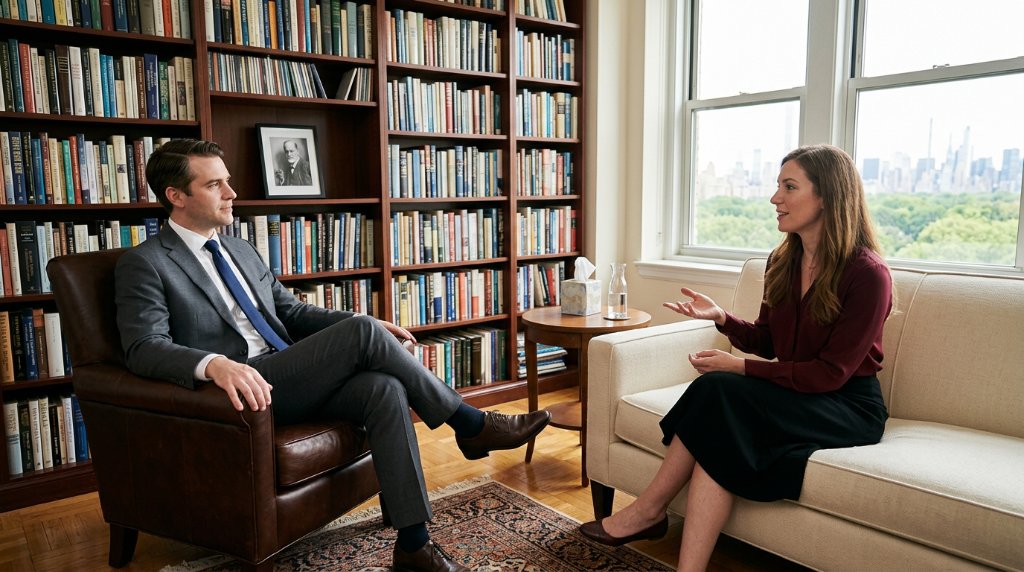
With the eyes closed, anticipation and trust take centre stage and the meaning of touch and pain changes — Image: AI-generated / Gemini 3.1 Flash via OpenRouter
What in the Body Turns Pain Into Pleasure?
Dunkley et al. (2020, Journal of Sex Research) reviewed the pain and BDSM literature and checked a theory with practitioners. No single factor explains the effect; interconnected factors include endogenous opioids and endocannabinoids, environmental context, emotional state, volition and control, interpersonal connection, sexual arousal, and memories.
Wuyts and Morrens (2022, Journal of Sexual Medicine) systematically reviewed 10 biological studies. They found cortisol changes in submissives, suggesting stress-system involvement, and endocannabinoid changes in the pleasure and reward system. Among dominants, measured pleasure depended more on power play than on pain play.
Pleasure from pain in BDSM is the sum of body and meaning; context, choice and trust steer the body’s chemistry. Biological studies are few and need replication. The integrated view aligns with today’s biopsychosocial understanding of sexual health.
Is the Trance-Like State of BDSM Real?
Practitioners describe time stretching and a quiet mind, often called “subspace”. Williams and Sprott (2022, Current Opinion in Psychology) report that kink activities can generate flow and transient hypofrontality, a temporary drop in prefrontal activity. Dunkley et al. suggest such altered states of consciousness may resemble those reached in contemplative practice.
Klement et al. (2017, Culture, Health & Sexuality) followed a 160-person Dance of Souls ritual. During the ritual, cortisol rose while psychological stress and negative affect fell; sexual arousal and felt overlap with others increased. Forer and Westlake (2025) surveyed 525 BDSM practitioners; those with chronic pain did not initially seek BDSM for pain management, but reported physical and mental benefits, and many reported some short-term pain relief.
In consensual BDSM the body may be on alert while the mind is calmer than before (Klement et al., 2017). The Klement et al. and Forer and Westlake findings rely on self-report and volunteer samples, so no causal conclusion can be drawn.
What Did Freud Discover About Pleasure in Pain, and How Does It Help Us Today?
Freud, in The Economic Problem of Masochism (1924; Standard Edition vol. 19, pp. 155–170), distinguished erotogenic masochism (sexual pleasure in pain), “feminine” masochism, and moral masochism. He saw erotogenic masochism as the most basic layer.
The distinction still helps: consensual play with clear limits, a safeword and aftercare is not the same as repeated harmful or humiliating situations in daily life. The first is conscious mutual play; the second resembles an unconscious need for punishment. Current research likewise sees consensual BDSM as a form of intimacy, in line with Freud’s distinction between erotogenic masochism and the unconscious need for punishment.
Clinical experience indicates that sex therapists commonly see clients who worry whether an interest in pain is normal rather than being harmed. Professional help is needed when limits are broken or when shame and self-blame remain after a scene.
Is enjoying pain during sex a sign of mental illness?
No. Wuyts and Morrens’ 2022 systematic review in the Journal of Sexual Medicine notes that research sees consensual BDSM as a healthy form of intimacy. Concern arises when pain occurs without consent, when limits are broken, or when shame and distress remain after a scene.
Why do BDSM practitioners seem to feel less pain?
Kamping et al. (2016, Pain) found people with masochistic preferences rated painful stimulation as substantially less intense and less unpleasant only in a masochistic context. Defrin et al. found 17 people who engaged in masochistic behaviour had a higher pressure pain threshold correlated with more frequent sessions.
What is subspace in BDSM?
Subspace is a practitioner-described altered state in which time seems to stretch and the mind quiets. Williams and Sprott (2022) link kink activities to flow and transient hypofrontality. Klement et al.’s Dance of Souls study found cortisol rose while psychological stress and negative affect fell.
When should an interest in pain be discussed with a professional?
If there is no consent, a safeword is ignored, injury occurs, or self-blame and shame continue after a scene, professional support may help. Freud’s 1924 distinction between erotogenic masochism and an unconscious need for punishment remains useful for separating conscious play from repeated harmful patterns.
Conclusion
Pain in consensual BDSM is not the same as unwanted everyday pain. When pain is wanted, controllable, and framed by a safe relationship, the brain appears to turn down its distress while the body’s reward systems seem to take part. Understanding this reduces shame and makes honest conversation about desire, limits, and care easier.
Looking for professional support with your relationship or mental health?
Kamping S, Andoh J, Bomba IC, et al. Contextual modulation of pain in masochists: involvement of the parietal operculum and insula. Pain. 2016;157(2):445-455. doi:10.1097/j.pain.0000000000000390. PMID 26808014
Defrin R, Arad M, Ben-Sasson MP, et al. Attitudes and emotions towards pain and sensitivity to painful stimuli among people routinely engaging in masochistic behaviour. Eur J Pain. 2015;19(9):1321-1330. doi:10.1002/ejp.662. PMID 25690315
Dunkley CR, Henshaw CD, Henshaw SK, et al. Physical Pain as Pleasure: A Theoretical Perspective. J Sex Res. 2020;57(4):421-437. doi:10.1080/00224499.2019.1605328. PMID 31044619
Wuyts E, Morrens M. The Biology of BDSM: A Systematic Review. J Sex Med. 2022;19(1):144-157. doi:10.1016/j.jsxm.2021.11.002. PMID 34876387
Klement KR, Lee EM, Ambler JK, et al. Extreme rituals in a BDSM context: the physiological and psychological effects of the ‘Dance of Souls’. Cult Health Sex. 2017;19(4):453-469. doi:10.1080/13691058.2016.1234648. PMID 27737624
Williams DJ, Sprott RA. Current biopsychosocial science on understanding kink. Curr Opin Psychol. 2022;48:101473. doi:10.1016/j.copsyc.2022.101473. PMID 36274435
Forer R, Westlake B. Pain for pain: the benefits and challenges of BDSM participation for people with chronic pain — an exploratory study. Psychology & Sexuality. 2025. PMID 40959519
Freud S. The Economic Problem of Masochism (1924). In: Strachey J, ed. The Standard Edition of the Complete Psychological Works of Sigmund Freud, Vol. 19. London: Hogarth Press; 1961:155-170.
Image Credits
Featured image: Photo: Vika Glitter / Pexels. Inline image 1: AI-generated image (Gemini 3.1 Flash via OpenRouter); no real person is depicted.