Does watching porn together damage a relationship, or can it heat it up? The short answer from research is: it depends on who watches, with whom, and whether it happens in secret or in the open. In several couple studies, partners who watch pornography together report higher sexual satisfaction than partners who each watch alone and in secret. This article looks at exactly what the data show, where caution is needed, and the key Freud offers for understanding the pattern.
What does research say about couples watching porn together?
One of the most cited studies, by Maddox and colleagues (2011), surveyed 1,291 unmarried people in romantic relationships. 76.8% of men and 31.6% of women said they sometimes viewed sexually explicit material alone, and 44.8% of all participants said they sometimes viewed it with their partner. Those who watched only with their partner reported more dedication and higher sexual satisfaction than those who watched only alone. The one difference between this group and people who never watched was a higher rate of infidelity.
Kohut and colleagues (2021) tested the same question in four couple samples: two cross-sectional (200 and 207 couples) and two longitudinal (77 and 277 couples). Across all of them, couples who watched pornography together reported higher relationship and sexual satisfaction than couples who did not, and the pattern held equally for women and men. Willoughby and Leonhardt, analysing 240 committed American couples, likewise found that joint use was associated with higher sexual satisfaction for both partners.
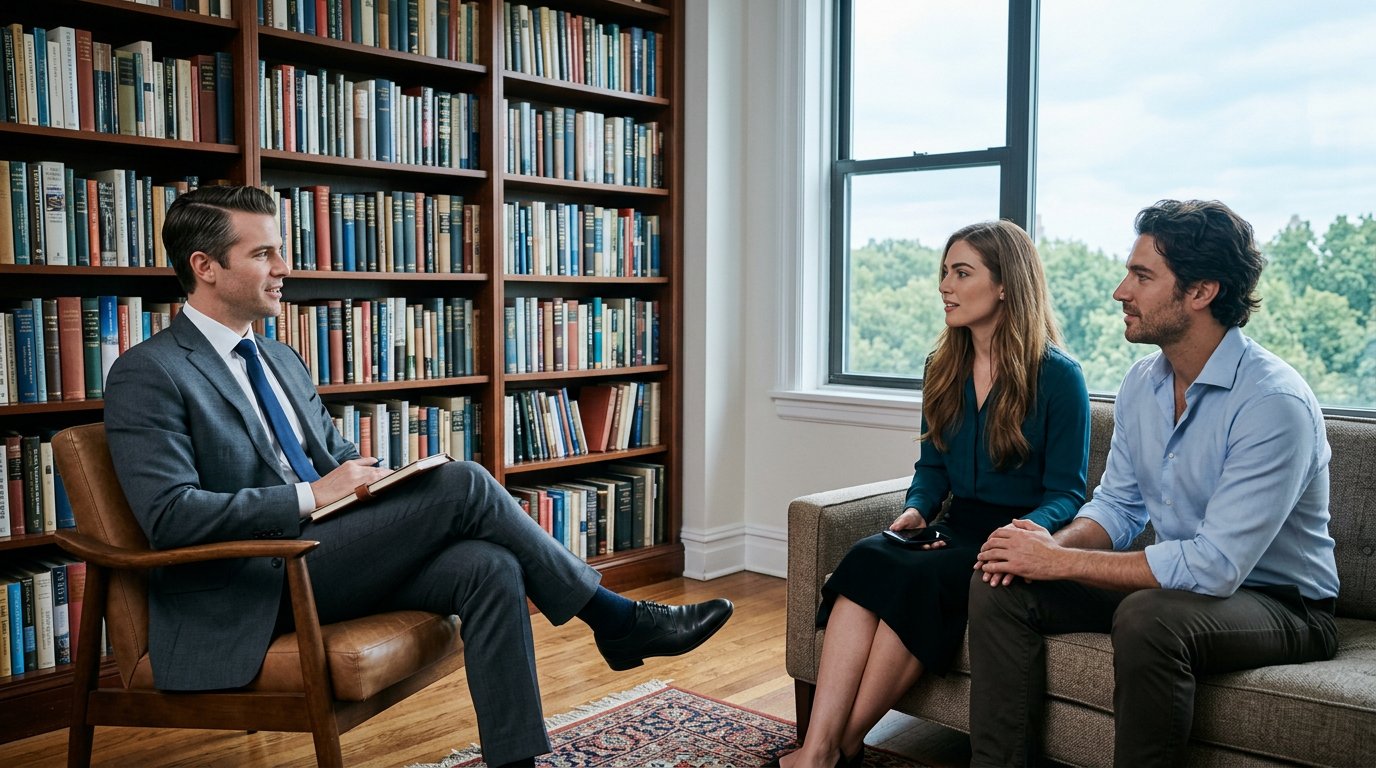
Open, shared porn viewing, unlike secret viewing, goes together with higher sexual satisfaction in couples — Image: AI-generated / Gemini 3.1 Flash via OpenRouter
Why does secret, solitary viewing look so different?
The same studies show a second picture. In Willoughby’s data, a man’s solo pornography use was linked with lower relationship satisfaction in both partners, lower sexual desire in the woman and less positive communication from the man, whereas a woman’s solo use was linked only with her own higher sexual desire. Perry (2020) combined 30 national US surveys covering 31 measures of relationship quality; where an association appeared at all, pornography use was usually linked with poorer relationship quality, although most of these associations were small.
Secrecy appears to be the key variable. Li and colleagues (2026) studied 1,223 partnered young adults aged 18 to 25 in China and the UK and separated three patterns: secret solitary use, solitary use the partner knows about, and shared use. Secret use was associated with lower sexual satisfaction and more sexual shame, while partner-aware and shared use were generally linked with better outcomes, especially for women. Kohut’s team also showed that part of the apparent harm of pornography is really a mismatch between partners: one watches a lot alone while the other barely watches at all, and behind that mismatch there is often a difference in sex drive.
These findings are correlations, not proof of cause and effect. Couples who already feel secure and talk openly about sex may simply find it easier to watch together. So porn is not a treatment; the more accurate statement is that openness and shared experience go together with higher satisfaction.
How can watching together boost desire and orgasm?
In an experiment by Staley and Prause with 44 couples, watching an erotic film raised arousal and increased the desire to be close to one’s partner, while also producing some guilt and anxiety. That double effect is the clinical key: sexual imagery can be an engine of arousal, provided it is experienced in a safe space with both partners’ consent. Dover and Willoughby, in a national sample of 2,519 people, showed that watching with a partner is a distinct activity from watching alone, and that its link with relationship outcomes runs partly through what the couple does sexually afterwards, such as vaginal intercourse and oral sex.
In practice, for many couples watching together becomes an opportunity to say things that are hard to put into words: “this scene turned me on”, “I’d like us to try this”, or “this one makes me uncomfortable”. That conversation, more than the film itself, is what helps desire, adequate clitoral stimulation and orgasm for both partners.
What does Freud say about the pleasure of looking?
In Three Essays on the Theory of Sexuality (1905; SE 7, pp. 156–157), Freud treats the pleasure in looking (scopophilia, Schaulust) as a natural part of human sexuality and presents looking as one of the important pathways by which libidinal excitation is aroused. In the same work (SE 7, pp. 208–212) he distinguishes fore-pleasure from end-pleasure: looking, touching and caressing build fore-pleasure and raise tension that then finds release in end-pleasure, that is, orgasm.
This Freudian framework explains clearly why shared and secret viewing are two different experiences. When a couple watches together, looking becomes fore-pleasure within a real relationship between two people, and its energy flows back toward the partner. When looking is secret and separate from the partner, the same fore-pleasure may complete its course in solitary masturbation and stay detached from the relationship. Shame and secrecy, as Freud showed throughout his work, push desire below the surface and create distance; open conversation is what brings desire back into the relationship.
Yes, and more common than many people assume. In the Maddox study, close to half of people in relationships said they sometimes watched with their partner. The marker of health is free consent from both partners and the absence of pressure, not the viewing itself.
If my partner watches porn in secret, does it mean they are unhappy with me?
Not necessarily. Research suggests that a difference in sex drive between partners explains much of this pattern. Secrecy is more often a sign of shame or fear of judgement than of lost interest; a conversation without blame is the first step.
Can watching porn together help a woman reach orgasm?
For some couples, yes, because it raises arousal and makes it easier to talk about wishes, including direct clitoral stimulation. In the China and UK data, open and shared viewing was linked with better outcomes, especially among women.
When does watching porn become a problem?
When it is secret and tied to shame, when one partner is unhappy but goes along under pressure, or when it replaces real sex between the couple. In those cases, talking with a sex therapist helps the couple find a shared pattern that works for both.
Conclusion: openness matters more than the porn itself
The data show that open, shared viewing, for couples who are both comfortable with it, goes together with higher sexual satisfaction, while secret and mismatched viewing goes together with shame and lower satisfaction. The good news is that these patterns are not fixed: any couple can, through honest conversation about desire, boundaries and fantasies, turn looking from a dividing secret into shared fore-pleasure and build a warmer relationship.
Looking for professional support with your relationship or mental health?
Maddox AM, Rhoades GK, Markman HJ. Viewing sexually-explicit materials alone or together: associations with relationship quality. Arch Sex Behav. 2011;40(2):441-448. PMID: 20039112. DOI: 10.1007/s10508-009-9585-4
Kohut T, Dobson KA, Balzarini RN, et al. But What’s Your Partner Up to? Associations Between Relationship Quality and Pornography Use Depend on Contextual Patterns of Use Within the Couple. Front Psychol. 2021;12:661347. PMID: 34393898. DOI: 10.3389/fpsyg.2021.661347
Willoughby BJ, Leonhardt ND. Behind Closed Doors: Individual and Joint Pornography Use Among Romantic Couples. J Sex Res. 2020;57(1):77-91. PMID: 30485135. DOI: 10.1080/00224499.2018.1541440
Li Y, Ingham R, Armstrong H. Pornography-use patterns and psychosexual well-being: cultural and gender differences among partnered young people in China and the UK. Cult Health Sex. 2026:1-15. PMID: 41486650. DOI: 10.1080/13691058.2025.2599255
Perry SL. Pornography and Relationship Quality: Establishing the Dominant Pattern by Examining Pornography Use and 31 Measures of Relationship Quality in 30 National Surveys. Arch Sex Behav. 2020;49(4):1199-1213. PMID: 31897829. DOI: 10.1007/s10508-019-01616-7
Staley C, Prause N. Erotica viewing effects on intimate relationships and self/partner evaluations. Arch Sex Behav. 2013;42(4):615-624. PMID: 23224749. DOI: 10.1007/s10508-012-0034-4
Dover CR, Willoughby BJ. Sexual Behaviors as a Mediator Between Pornography Use and Heterosexual Relationship Outcomes. Arch Sex Behav. 2024;53(2):689-701. PMID: 37735277. DOI: 10.1007/s10508-023-02698-0
Freud S. (1905). Three Essays on the Theory of Sexuality. In: Strachey J, ed. The Standard Edition of the Complete Psychological Works of Sigmund Freud, Vol. 7. London: Hogarth Press: 123-245.
Image Credits
Featured image and in-text image 1 — Image: AI-generated / Gemini 3.1 Flash via OpenRouter. Therapist session image — Image: AI-generated / Gemini 3.1 Flash via OpenRouter.