Smartphone use has not been shown to cause erectile dysfunction. What the evidence offers is a statistical association between problematic use and lower sexual function scores, measured by self-report, plus one small pilot comparison of two groups of men. Neither design can establish that the phone produced the problem.
The claim of causation runs ahead of the data. The studies describe how much and how compulsively people use a phone, not what the device does to the body.
Do smartphones actually cause erectile dysfunction?
No study has shown that smartphones cause erectile dysfunction. The 2013 pilot study compared 20 men with erectile dysfunction lasting at least 6 months and 10 men without erectile complaints, and the only significant difference between the groups was in hours per day spent carrying a switched-on phone, not in talk time.
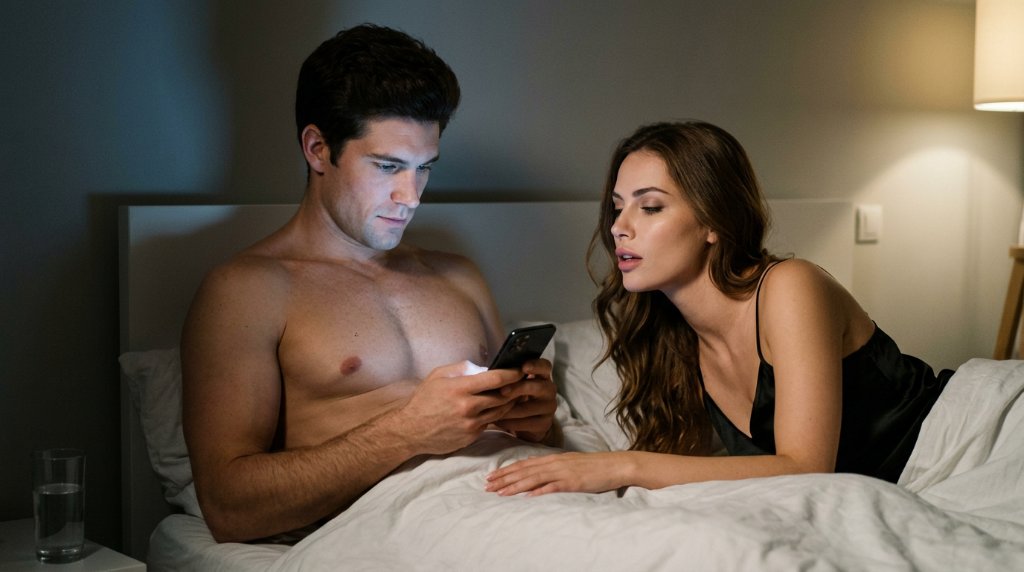
The man absorbed in his phone while his partner waits; AI-generated image.
On the Sexual Health Inventory for Men, the 20 men with erectile dysfunction scored 11.2 (standard deviation 5) and the 10 men without erectile complaints scored 24.2 (standard deviation 2.3). The groups did not differ significantly in age, weight, height or total testosterone. Talk time on the phone was 17.6 hours per week (standard deviation 11.1) in the group with erectile dysfunction and 12.5 hours per week (standard deviation 7) in the group without erectile complaints, which was not a significant difference. Carrying a switched-on phone accounted for 4.4 hours per day (standard deviation 3.6) in the group with erectile dysfunction and 1.8 hours per day (standard deviation 1) in the group without erectile complaints, a significant difference. The authors described a pilot study with a potential correlation and recommended larger studies and exploration of mechanisms.
In clinical work, specialists often see that men who worry about the phone beside the bed are really talking about performance anxiety; this is a clinical impression, not a result of these studies. The 2013 pilot study measured 30 men in total, so cause and effect cannot be separated.
How does compulsive social media use relate to sexual function?
Compulsive social networking site use, not smartphone use in general, shows the strongest association with sexual function. In a 2022 analysis pooling 4 studies with data from 2019 to 2021, addictive-like social networking site use correlated negatively with several aspects of sexual function in men, in a sample that was not representative.
In that 2022 analysis in Portugal, problematic smartphone use was assessed in 235 men and 946 women, and problematic social networking site use in 194 men and 536 women, all by self-report. In men, addictive-like social networking site use correlated with erectile function at r = -0.26, with desire at -0.17, with intercourse dissatisfaction at -0.20, with overall sexual dissatisfaction at -0.30 and with difficulty reaching orgasm at -0.20. Correlations for smartphone use itself were weaker and mostly became non-significant after controlling for social networking site use. Women showed a similar direction.
One simple calculation, ours rather than a number from the paper: 0.26 squared is about 0.068, so roughly 7 percent of the spread in erectile function scores in this sample goes together with addictive-like social networking site use, and about 93 percent with something else.
What mechanisms could sit behind this association?
No mechanism has been tested. The 2013 pilot study and the 2022 analysis measured associations at a single point in time or by self-report, and neither manipulated phone use or followed men over time. Any explanation of why the association appears therefore remains a hypothesis rather than a finding.
Four hypotheses exist, and none was tested in these two studies. The first is sleep lost to screen light, with late phone use shortening sleep. The second is performance monitoring and comparison that breeds anxiety. The third is divided attention in the moment of intimacy. The fourth reverses the direction: a man who notices erectile difficulty retreats to the phone more.
In the classical psychoanalytic framework of Freud, psychic energy is limited, and attention invested in one object is taken from another; this insight helps explain how attention is distributed. The 2013 pilot study recorded 4.4 hours per day of carrying a switched-on phone in its 20 men with erectile dysfunction without testing whether that carrying affected their erections.
What should you do if you are worried about your phone and your erections?
If you are worried, treat the phone as a habit to examine rather than a device to fear, and look at the parts of use you can change: timing, duration and presence during intimacy. If erectile difficulty repeats or is distressing, seeing a doctor to assess physical and psychological causes is right.
One low-cost experiment is keeping the phone away from the bed at night for a period you choose, then noting whether sleep and sexual function change. That experiment does not follow from these two studies, and improvement is not guaranteed; it gathers information about your own pattern.
The editorial position of Behckam.com is that the current evidence speaks of association, not cause; the better question is how and how much the phone is used, not whether you own one. The 2022 analysis in Portugal found that in 194 men, addictive-like social networking site use correlated with erectile function at r = -0.26, a modest correlation that does not settle direction.
Does keeping a switched-on phone in your pocket directly weaken erections?
The 2013 pilot study reported that the 20 men with erectile dysfunction carried a switched-on phone for 4.4 hours per day, the 10 men without erectile complaints for 1.8 hours per day, and that its design cannot show causation.
Does talk time on the phone matter?
In the 2013 pilot study, talk time was 17.6 hours per week (standard deviation 11.1) in the 20 men with erectile dysfunction and 12.5 hours per week (standard deviation 7) in the 10 men without erectile complaints, not a significant difference.
Is addictive-like use or the phone itself more important?
In the 2022 analysis in Portugal, correlations for smartphone use itself were weaker and mostly became non-significant once addictive-like social networking site use was controlled, which points to how the phone is used rather than the device.
When should you see a doctor?
If erectile difficulty repeats or is distressing, seeing a doctor to assess physical and psychological causes is right. The 2022 analysis in Portugal is correlational, and the 2013 pilot study cannot separate cause from effect.
Conclusion: The Concern Is Fair, a Firm Claim Is Not
A man who notices that his phone use tracks with his erections is observing something real, and the 2013 pilot study and the 2022 analysis both point to an association rather than a cause. Neither study tested a mechanism, so cause remains unestablished. What remains open is also what can be acted on: use can be examined and changed, and distress has clinical routes, though improvement is not guaranteed.
Looking for professional support with your relationship or mental health?
Al-Ali BM, Patzak J, Fischereder K, et al. Cell phone usage and erectile function. Cent European J Urol. 2013;66(1):75-7. PMID: 24578997. DOI: 10.5173/ceju.2013.01.art23
Fuzeiro V, Martins C, Gonçalves C, et al. Sexual Function and Problematic Use of Smartphones and Social Networking Sites. J Sex Med. 2022;19(8):1303-1308. PMID: 35718741. DOI: 10.1016/j.jsxm.2022.05.004
Image Credits: The featured and in-text images in this article are AI-generated (Google Gemini).