If you sleep less than your body needs and find yourself uninterested in sex the next night, it is not a coincidence. Sleep research shows that short sleep lowers sexual desire, slows arousal and, in men, is linked to weaker erections. The short answer: yes, poor sleep can switch sex off, but the good news is that the effect is reversible. In a daily study of 171 women, every extra hour of sleep raised the odds of partnered sex the following day by 14%. Sleep is the hidden foreplay of a good sex life.
David Kalmbach and colleagues at the University of Michigan followed 171 women for fourteen consecutive days. Each morning, participants reported how long and how well they had slept, then rated their desire, arousal, orgasm and sexual activity for the day. The result was clear: longer sleep predicted greater sexual desire the next day, and each additional hour of sleep increased the odds of partnered sexual activity by 14%. Importantly, the link held independently of daytime mood and fatigue, so sleep does not act only through feeling “too tired”.
A subtler finding emerged as well: night to night, longer sleep on a given evening actually predicted slightly poorer genital arousal the next day, yet women who slept longer on average reported better genital arousal, meaning lubrication and physical readiness. What matters more than a single good night is a stable pattern of sufficient sleep. The limitation deserves mention: the sample was small and drawn from a university setting, and the authors themselves called it a pilot study [needs further review: replication in larger, midlife samples].
An unmade bed and a glowing phone: after nights that are cut short, desire the next day is quieter too. — Photo: Yusuf P / Pexels
Does Short Sleep Also Lower Erections and Testosterone in Men?
In men the evidence comes from two directions. The first is hormonal: Rachel Leproult and Eve Van Cauter reported in JAMA that just one week of sleep restriction in young, healthy men lowered their testosterone levels. Testosterone is one of the main fuels of male sexual desire, so nights that are cut short are paid for in the bedroom as well.
The second direction is sleep disorders. A 2026 meta-analysis by Pang and colleagues in the International Journal of Impotence Research found that the more severe obstructive sleep apnea is (a higher apnea-hypopnea index and lower nighttime oxygen), the lower the erectile function score; the prevalence of erectile dysfunction among men with apnea ranged from 59% to 69%. Another meta-analysis from the same year found that both apnea and shift-work sleep disorder were associated with weaker erections and lower testosterone, with apnea showing the stronger effect. Heterogeneity across studies was high, and one Mendelian randomization study did not confirm a direct causal link [needs further review: the roles of obesity and age], but the clinical message is clear: a man who presents with erectile dysfunction should also be asked about his sleep and his snoring.
Why Does Fatigue Create Sexual Distance Between Partners?
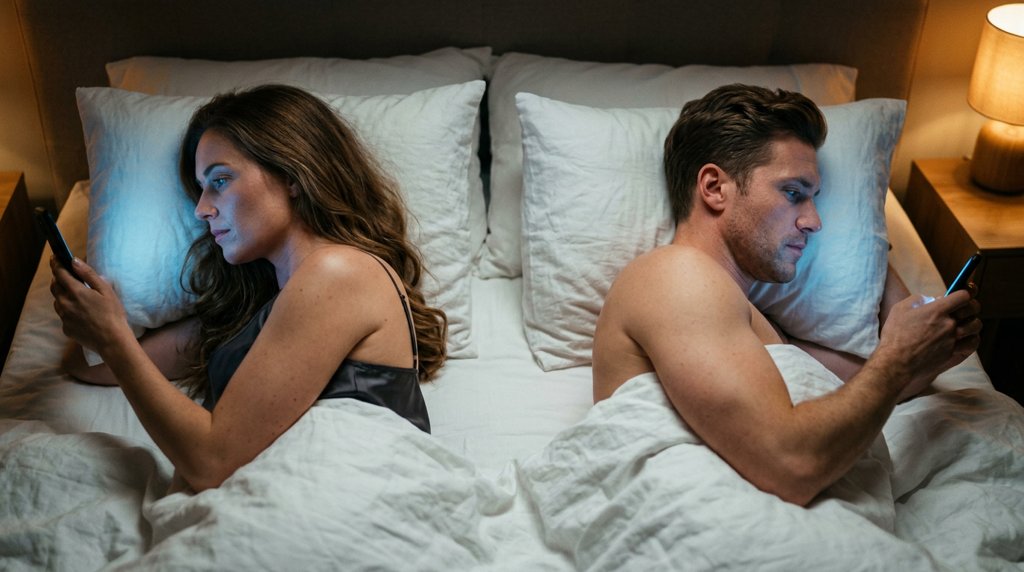
In many homes the bedroom is no longer a place for sleep and sex; it is a place for work email, social media and streaming. Two people lie side by side, each lit by the blue glow of their own phone, while midnight comes and goes. The result is double: sleep gets shorter, and the very minutes before sleep that were a natural window for touch, kissing and penetration are lost. The next day both partners are more tired and less interested, and the cycle continues.
When one partner sleeps less, because of shift work or a new baby, for example, a desire discrepancy takes shape. The more tired partner tends to see turning down sex as “normal”, while the other experiences it as rejection. In couples therapy, simply clarifying that part of this coolness is rooted in exhaustion rather than in fading love lifts a heavy weight off the relationship.
What Is Freud’s Insight Into Sleep and Libido?
In “On Narcissism: An Introduction” (1914; SE 14: 67-102), Sigmund Freud explains that the state of sleep, like illness, involves withdrawing libido from the outside world back onto the self; in sleep, all emotional investment is concentrated on a single wish, the wish to sleep. In “A Metapsychological Supplement to the Theory of Dreams” (1917; SE 14: 217-235) he develops the idea further: sleeping means a temporary return of the psyche to a state that needs neither the world nor its objects.
Freud’s insight illuminates the experience of every exhausted couple. When the psyche is depleted by lack of sleep, libido is drawn toward the self and its need for rest, and less energy remains for investing in the partner, that is, for desire directed at another person. Lower desire on exhausted nights is therefore not a sign that love has ended; it is the sign of a psyche that first wants to restore itself. The psychoanalytic answer is not blame but restoring adequate sleep, so that libido is freed again and can flow back toward the partner. Kalmbach’s finding that desire rises after longer sleep fits this Freudian picture closely.
There is no magic number, but in Kalmbach and colleagues’ daily study each additional hour of sleep raised the odds of partnered sex the next day by 14%. For most adults, sufficient and regular nightly sleep is the foundation of desire, arousal and stable erections.
Can lack of sleep cause erectile dysfunction?
Chronic short sleep, and especially obstructive sleep apnea, is linked to weaker erections. In a 2026 meta-analysis, more severe apnea went with lower erectile function scores, and 59% to 69% of men with apnea had erectile dysfunction. Loud snoring and daytime sleepiness deserve a medical check.
Why do I lose interest in sex when I am tired while my partner does not?
Fatigue pulls psychic energy away from the outside world and the partner and back toward the self, what Freud described as the withdrawal of libido. When one partner sleeps less, a desire discrepancy appears that usually signals exhaustion rather than emotional coldness.
Does using a phone in bed hurt our sex life?
Phones in bed work against intimacy twice: they shorten sleep, and they take over the minutes before sleep that were a natural window for touch and conversation. Keeping phones outside the bedroom is the simplest step that improves both sleep and sexual closeness.
The Bottom Line: Sleep Is the Hidden Foreplay
Sleep loss lowers sexual desire, slows arousal and, in men, goes hand in hand with lower testosterone and weaker erections. The same findings point the way back: every extra hour of sleep raises the odds of sex. Move phones out of the bedroom, protect sleep time for both partners, and have loud snoring or daytime sleepiness checked. When the psyche is rested, libido returns to the partner, and the bedroom becomes a place of intimacy and sexual pleasure again.
Looking for professional support with your relationship or mental health?
Kalmbach DA, Arnedt JT, Pillai V, Ciesla JA. The impact of sleep on female sexual response and behavior: a pilot study. J Sex Med. 2015;12(5):1221-32. PMID: 25772315. DOI: 10.1111/jsm.12858
Leproult R, Van Cauter E. Effect of 1 week of sleep restriction on testosterone levels in young healthy men. JAMA. 2011;305(21):2173-4. PMID: 21632481. DOI: 10.1001/jama.2011.710
Pang KH, Tong KS, Muneer A, Alnajjar HM. The association between obstructive sleep apnoea and erectile dysfunction: a systematic review and meta-analysis. Int J Impot Res. 2026. PMID: 42410062. DOI: 10.1038/s41443-026-01315-7
Almurayyi M, Alshahrani ST, Alshardi WI, et al. Sleep disorders and male sexual dysfunction: a meta-analysis of hormonal and erectile outcomes. Arch Ital Urol Androl. 2026;98(3):15659. PMID: 42707009. DOI: 10.4081/aiua.2026.15659
Gao Q, Chen P, Li Y, Zhu L. Assessing causality between obstructive sleep apnea and erectile dysfunction: a bidirectional Mendelian randomization study. Arch Esp Urol. 2025;78(8):1092-1100. PMID: 41111381. DOI: 10.56434/j.arch.esp.urol.20257808.142
Freud S. (1914). On Narcissism: An Introduction. In: Strachey J, ed. The Standard Edition of the Complete Psychological Works of Sigmund Freud, Vol. 14. London: Hogarth Press: 67-102.
Freud S. (1917). A Metapsychological Supplement to the Theory of Dreams. In: Strachey J, ed. The Standard Edition of the Complete Psychological Works of Sigmund Freud, Vol. 14. London: Hogarth Press: 217-235.
Image Credits
Featured image and therapist image — Image: AI-generated / Gemini 3.1 Flash via OpenRouter. In-text image — Photo: Yusuf P / Pexels.