Why does an unanswered message feel like an alarm? Research and psychoanalysis show anxious attachment can change and relationship security can be built.
Anxious attachment is a relational pattern in which a person fears a partner will leave or withdraw. It shows up as hypervigilance to delayed replies and shifts in tone. The pattern involves a low threshold for sensing rejection and a strong need for reassurance. It is changeable. In a study of 32 couples in couple therapy, attachment anxiety first rose slightly at “softening” moments and then decreased significantly across later sessions (Burgess Moser et al., Journal of Marital and Family Therapy, 2018).
What Exactly Is Anxious Attachment, and Where Does It Come From?
Researchers describe adult bonds along two dimensions: attachment anxiety, the fear of rejection and abandonment, and attachment avoidance, a flight from closeness. Attachment theory traces these patterns to early caregiving that was unpredictable.
In latent profile analyses of 1,663 community adults and 575 clinical adults, profiles were secure, preoccupied, dismissive, and fearful in the community sample, and secure, preoccupied, and fearful in the clinical sample (Vaillancourt-Morel et al., Journal of Marital and Family Therapy, 2022). Women were overrepresented in the preoccupied profile, men in the dismissive profile. Insecure participants reported more relationship dissatisfaction and distress; self-report limits causal conclusions.
Quotable: In a sample of 1,663 adults, insecurely attached people reported more relationship dissatisfaction, a finding consistent with the consensus in adult attachment research.
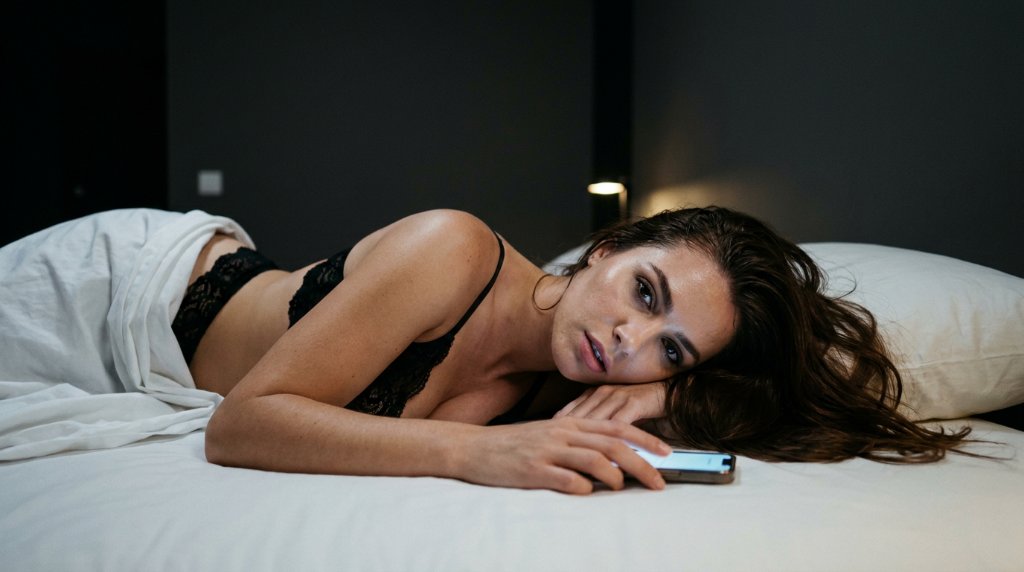
Midnight, a phone in hand and a message that does not come; the anxious mind reads silence as a sign of leaving — Image: AI-generated / Gemini 3.1 Flash via OpenRouter
Why Does the Anxious Mind “Test” a Partner?
People high in attachment anxiety feel hurt more intensely. In a 2014 Journal of Personality and Social Psychology study, they felt greater hurt on days with partner criticism or conflict and during observed conflict discussions, and expressed hurt in exaggerated ways that induced guilt. This helped them see the partner’s commitment as more stable and evaluate the relationship more positively, but it significantly reduced partner satisfaction.
Quotable: For the anxious partner, dramatic hurt may temporarily quiet the fear; for the other partner, it often becomes a slowly accumulating cost.
Social media can tighten the loop. In a two-year study of 322 adults aged 18 to 29, social media jealousy was associated with more electronic partner surveillance and lower satisfaction one year later; the attachment anxiety–satisfaction link became non-significant once jealousy and surveillance were accounted for (Métellus et al., Journal of Marital and Family Therapy, 2025). Limitations include a young-adult sample and self-report. For couples separated by migration or time zones, the phone screen is sometimes the only window into the relationship, which tightens this trap.
What Does Psychoanalysis Say About the Fear of Being Left?
In Inhibitions, Symptoms and Anxiety (1926), Freud framed anxiety as a reaction to the danger of losing the loved object, then of losing that person’s love. A current partner can become a screen on which an older absence is replayed.
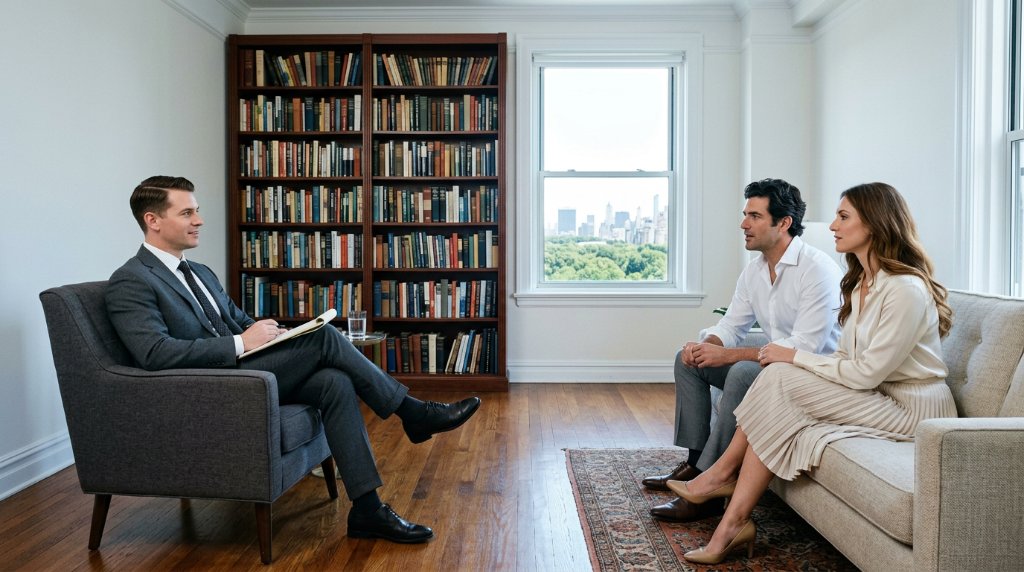
Clinically, clients often say, “I know it’s too much, but I can’t calm down until they reply.” The partner, tired of repeated reassurance, pulls back a little, confirming the original fear. In most of these relationships the core problem is not a lack of love but an alarm system set long before this relationship.
This is not about blame. Understanding where the alarm comes from lets a person separate what is happening now from what is being felt from the past.
Can Anxious Attachment Change?
In a 2018 study of 32 couples in therapy, 16 reached a “softening” moment where the more critical partner showed vulnerability and asked for closeness. Relationship satisfaction rose at that session. Attachment anxiety first rose slightly, then decreased significantly across later sessions (Journal of Marital and Family Therapy, 2018); the sample was small, so replication is needed.
Perceived gratitude may help. Across five studies, perceiving a partner’s gratitude buffered the negative effect of insecure attachment on satisfaction, and the person’s perception mattered more than the partner’s self-reported gratitude (Park et al., Journal of Personality and Social Psychology, 2019). The protective effect was clearest for avoidant attachment; for anxious attachment, evidence is less consistent [Further research needed].
Practical steps can interrupt the loop. Name the fear instead of testing the partner, for example, “When you don’t answer, I get scared.” Agree on predictable signals, such as a short message on busy days, and consciously reduce social media checking. If anxiety takes over most days, conflicts repeat, or sleep and work suffer, speaking to a mental-health professional or couples therapist is sensible.
No. Anxious attachment is a pattern in close relationships, not a clinical diagnosis. A 2022 study in the Journal of Marital and Family Therapy linked insecure profiles with more relationship dissatisfaction and psychological distress, but this describes a way of relating, not an illness.
Why can’t I calm down even after my partner reassures me?
Reassurance may not fully land because the fear predates the moment. In the Journal of Personality and Social Psychology (2014), anxious individuals felt hurt more intensely during conflict, and their exaggerated expressions induced partner guilt, which temporarily calmed them but reduced the partner’s satisfaction.
Does checking a partner’s social media harm the relationship?
Possibly. In the Journal of Marital and Family Therapy (2025), social media jealousy was associated with more electronic partner surveillance and lower relationship satisfaction one year later among 322 young adults. Once jealousy and surveillance were accounted for, the attachment anxiety–satisfaction link was no longer significant.
Can anxious attachment be treated?
Yes, change is possible. In a 2018 study of 32 couples in couple therapy, attachment anxiety first rose slightly at “softening” moments and then decreased significantly across later sessions (Journal of Marital and Family Therapy). The sample was small and needs replication, but the pattern is promising.
Conclusion: Can You Feel Safe in a Relationship?
Safety is not the absence of anxiety but the gradual discovery that anxiety can be named and calmed. Anxious attachment is an over-sensitive alarm, not evidence of being too much. With predictable contact and less surveillance, relationships can teach it a different rhythm.
Looking for professional support with your relationship or mental health?
Vaillancourt-Morel MP, Labadie C, Charbonneau-Lefebvre V, et al. A latent profile analysis of romantic attachment anxiety and avoidance. J Marital Fam Ther. 2022;48(2):391-410. doi:10.1111/jmft.12503. PMID: 33844320
Overall NC, Girme YU, Lemay EP, et al. Attachment anxiety and reactions to relationship threat: the benefits and costs of inducing guilt in romantic partners. J Pers Soc Psychol. 2014;106(2):235-256. doi:10.1037/a0034371. PMID: 24079298
Métellus S, Vaillancourt-Morel MP, Brassard A, et al. Attachment Anxiety and Relationship Satisfaction in the Digital Era: The Contribution of Social Media Jealousy and Electronic Partner Surveillance. J Marital Fam Ther. 2025;51(4):e70074. PMID: 40965283
Burgess Moser M, Johnson SM, Dalgleish TL, et al. The Impact of Blamer-softening on Romantic Attachment in Emotionally Focused Couples Therapy. J Marital Fam Ther. 2018;44(4):640-654. doi:10.1111/jmft.12284. PMID: 28988437
Park Y, Impett EA, MacDonald G, et al. Saying “thank you”: Partners’ expressions of gratitude protect relationship satisfaction and commitment from the harmful effects of attachment insecurity. J Pers Soc Psychol. 2019;117(4):773-806. doi:10.1037/pspi0000178. PMID: 30702317
Freud S. Inhibitions, Symptoms and Anxiety (1926). In: The Standard Edition of the Complete Psychological Works of Sigmund Freud, Vol. 20. London: Hogarth Press.
Image Credits: AI-generated images (Gemini 3.1 Flash via OpenRouter). No real person is depicted.