If ejaculation arrives sooner than you and your partner want, part of the answer lies in muscles few people think about: the pelvic floor. Recent research shows that targeted training of these muscles over eight weeks increases ejaculatory latency in many men and lowers sexual anxiety. Yet training alone is no miracle; its effect is smaller than medication or combined approaches, and when combined with slow breathing, bodily awareness, and dialogue with a partner, it becomes more durable. Here is what the evidence actually says, and why body and mind are inseparable in ejaculatory control.
What Role Do Pelvic Floor Muscles Play in Ejaculation?
Ejaculation is a neural reflex that occurs in two phases: first, semen is propelled into the urethra, and then the pelvic floor muscles, especially the bulbospongiosus at the base of the penis, expel it with rhythmic contractions. The idea behind pelvic floor training is simple: a man who knows these muscles can consciously relax or contract them, and in moments close to orgasm, instead of letting the reflex carry him away, he can regulate the pace of stimulation himself.
Premature ejaculation is common. A meta-analysis from 2026 in the Journal of Sexual Medicine estimates its prevalence at between 5 and 15 percent of men. Researchers distinguish two main types: 'lifelong' premature ejaculation, present since first sexual experiences, and 'acquired' premature ejaculation, which develops after a period of normal functioning.
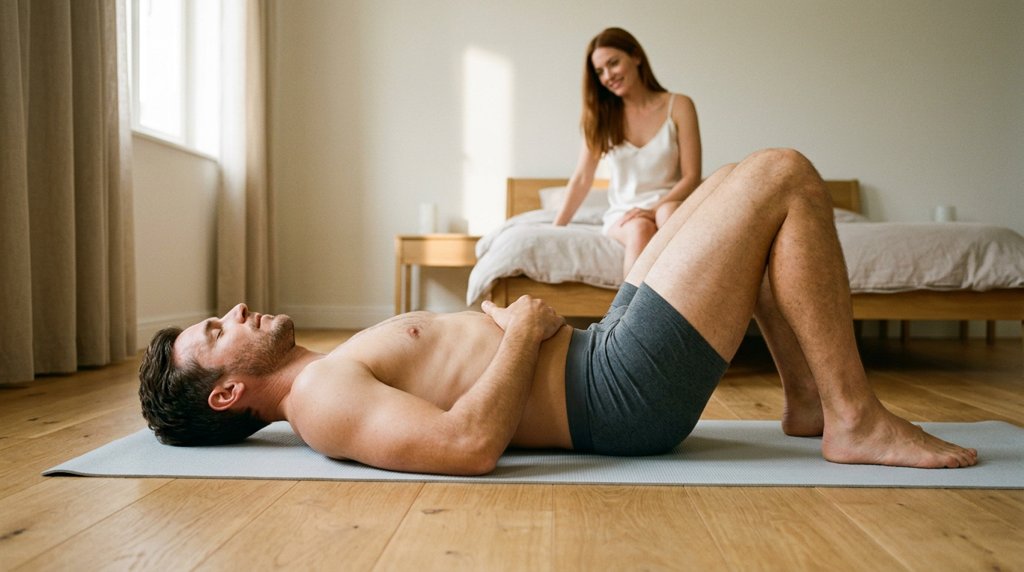
Pelvic floor awareness and slow breathing: two bodily tools for ejaculatory control — Image: AI-generated / Gemini 3.1 Flash via OpenRouter
What Do Studies Say About Pelvic Floor Training for Premature Ejaculation?
The systematic review by Myers and Smith (2019) examined ten trials and concluded that pelvic floor muscle training improved both erection and ejaculatory control in most studies; however, the methodological quality of the studies was low to moderate, and no single training program was identified as best.
The study by Lyu et al. (2025) with 199 men looked more closely. After eight weeks of training with biofeedback, in men with acquired premature ejaculation the median time to ejaculation during vaginal intercourse rose from 120 seconds to 180 seconds. In the lifelong group, the figure went from 30 to 60 seconds. Anxiety and depression scores decreased in both groups, and the benefit was greater for the acquired group. The authors themselves note that there was no sham control group and no long-term follow-up.
The most recent picture comes from the meta-analysis by de Oliveira et al. (2026). This study pooled five randomized trials with 236 men. The result was that pelvic floor training alone, compared with pharmacological treatment or combined methods, had a smaller effect on ejaculatory latency; the mean difference was about 54 seconds in favor of the comparison groups. The practical message: pelvic floor training is a useful tool, and according to the same meta-analysis, combining it with diaphragmatic breathing or other approaches may produce a larger effect. [Needs further review: the number of trials is small and heterogeneity among them is high.]
Why Does Slow Breathing Make the Training More Durable?
The randomized trial by Erkut et al. (2025) in Turkey gave 62 men with premature ejaculation eight weeks of behavioral training and pelvic floor muscle training, and added daily diaphragmatic breathing to half of them. The group that also practiced breathing had a median increase in ejaculatory latency of 283 seconds, while the other group gained 204 seconds. More importantly, after one year, the effect clearly diminished in the group without breathing, but persisted in the breathing group. Heart rate variability indices also showed that slow breathing shifted the balance of the autonomic nervous system toward calm.
The physiological explanation is understandable: the ejaculatory reflex is under the command of the sympathetic branch of the nervous system, the same branch activated in anxiety and excitement. A man who takes short, shallow breaths during intercourse is unknowingly driving his body toward rapid ejaculation. Deep, slow breathing reduces this acceleration and gives the pelvic floor muscles the opportunity to consciously relax.
Freud's Insight: Why Is Ejaculatory Control a Task of the 'Bodily Ego'?
Freud writes in The Ego and the Id (1923; SE 19, p. 26) that the ego is above all a 'bodily ego'; that is, the 'I' is constructed from the perception of the body and its sensations. This insight is key to understanding pelvic floor training. A man who does not know his pelvic muscles experiences a part of his own body as outside the territory of the 'I' at the peak of stimulation; ejaculation 'happens to' him. Conscious training brings this very part back into the ego and transforms ejaculation from an involuntary event into a regulated action.
In Inhibitions, Symptoms and Anxiety (1926; SE 20, pp. 87-90), Freud includes disturbances of male sexual function, including premature ejaculation, among the phenomena that the ego produces in the face of anxiety. This framework explains why in the Lyu study, the reduction of anxiety and the improvement in ejaculatory latency occurred simultaneously, and why in clinical work we see body and mind together: physical training gives the ego tools, and psychoanalytic dialogue puts into words the anxiety hidden beneath ejaculatory acceleration. For a couple coming to therapy together, these two paths reinforce each other.
How long does it take for pelvic floor training to affect premature ejaculation?
In the two recent trials by Lyu and Erkut, the training period was eight weeks. In Lyu et al., after these eight weeks ejaculatory latency increased with statistical significance in both types of premature ejaculation. The result is gradual and depends on continued practice; in the Erkut trial, the effect faded after one year in the group that did not practice breathing.
Is pelvic floor training useful for lifelong premature ejaculation?
Yes, but its effect is smaller. In Lyu's 199-man study, men with lifelong premature ejaculation improved from 30 to 60 seconds, while the acquired group benefited more. In the lifelong type, combining physical training with specialist evaluation and therapeutic dialogue usually yields a better result.
Why does diaphragmatic breathing help control ejaculation?
Ejaculation is under the command of the sympathetic nervous system, which is activated by anxiety. Slow, deep breathing calms this branch. In the Erkut trial, adding diaphragmatic breathing both increased ejaculatory latency and kept the effect stable after one year.
Should the partner participate in this process?
Partner involvement makes the process easier. When both understand the purpose of the training, performance pressure decreases and sexual intercourse becomes a calm practice space. The reduction of anxiety, which in studies appears together with improved control, is more easily achieved in a supportive couple atmosphere.
Conclusion: A Body You Know, an Ejaculation You Control
Premature ejaculation is not fate. Current evidence shows that recognizing and training the pelvic floor muscles, especially together with slow breathing, increases ejaculatory latency within eight weeks and reduces anxiety. This training alone is not complete, but it is a valuable part of a path in which body and mind are seen together. When the body returns to the territory of the 'I', sexual intercourse is transformed from a performance test into a shared and pleasurable experience.
Looking for professional support with your relationship or mental health?
Myers C, Smith M. Pelvic floor muscle training improves erectile dysfunction and premature ejaculation: a systematic review. Physiotherapy. 2019;105(2):235-243. PMID: 30979506. DOI: 10.1016/j.physio.2019.01.002
Lyu Y, Gong J, He H, Xu H, Dong H, Duan Y. Differential efficacy of pelvic floor muscle training in primary versus acquired premature ejaculation: an 8-week comparative study using non-invasive biomechanical assessment. Sex Med. 2025;13(5):qfaf081. PMID: 41090039. DOI: 10.1093/sexmed/qfaf081
Erkut U, Karagozoglu Coskunsu D, Erkut K, Ozden AV. The effects of diaphragmatic breathing exercises on individuals with premature ejaculation: a randomized controlled trial. J Sex Med. 2025;22(8):1422-1429. PMID: 40580936. DOI: 10.1093/jsxmed/qdaf107
de Oliveira FA, Lima LB, da Costa MO, Uchôa SMM, Lenzi J, Gouveia GPM. Efficacy of pelvic floor muscle training in the management of premature ejaculation: a systematic review and meta-analysis of randomized controlled trials. J Sex Med. 2026;23(6). PMID: 42132359. DOI: 10.1093/jsxmed/qdag131
Freud S. (1923). The Ego and the Id. In: Strachey J, ed. The Standard Edition of the Complete Psychological Works of Sigmund Freud, Vol. 19. London: Hogarth Press: 12-66.
Freud S. (1926). Inhibitions, Symptoms and Anxiety. In: Strachey J, ed. The Standard Edition of the Complete Psychological Works of Sigmund Freud, Vol. 20. London: Hogarth Press: 87-175.
Image Credits
Featured image and in-text image — Image: AI-generated / Gemini 3.1 Flash via OpenRouter.