A diagnosis in which sexual behavior becomes repetitive and hard to control draws attention from clinicians and researchers alike. Hormonal findings in this field remain thin and hard to interpret.
One hormonal observation concerns oxytocin, and its meaning is narrower than headlines suggest. Evidence of causality has not been established.
Is oxytocin higher in men with compulsive sexual behavior?
Higher plasma oxytocin was reported in men with hypersexual disorder, described in the 2022 study as excessive and persistent sexual behavior, than in comparison volunteers; the answer within that sample is yes, although the finding comes from a single university hospital clinic and this study included only men.
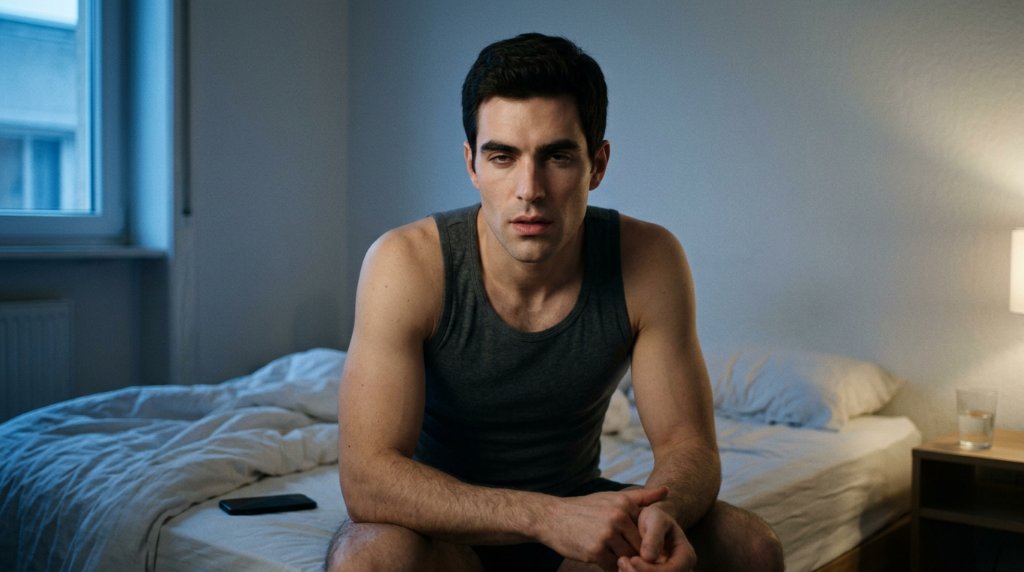
Closeness at dawn; oxytocin has been studied in relation to bonding and sexual behavior — Image: AI-generated / Gemini 3.1 Flash via OpenRouter
The 2022 study at a university hospital clinic compared 64 men with hypersexual disorder and 38 age-matched healthy volunteers. Plasma oxytocin, measured by radioimmunoassay, averaged 31.0 pM with a standard deviation of 9.9 in the affected men and 16.9 pM with a standard deviation of 3.9 in the healthy volunteers; the difference was statistically significant, with P below 0.001.
Oxytocin in those 64 men correlated positively and significantly with scores on hypersexual behavior rating scales. A 2025 systematic review of peripheral biomarkers in compulsive sexual behavior disorder, based on 10 articles about adults with a formal diagnosis, also reported higher plasma oxytocin; its authors called the biological findings preliminary and their clinical application limited.
Compulsive sexual behavior disorder is classified as an impulse control disorder in the 11th revision of the International Classification of Diseases. The 2022 study carries limits: men only, a single centre, measurement in blood, and no untreated comparison group for the post-treatment measurement.
What changed after a group psychological treatment programme?
Among 30 men who completed a manual-based group psychological treatment programme, plasma oxytocin fell from 30.5 pM to 20.2 pM, a statistically significant change, yet the 2022 abstract reports no untreated comparison group, so improvement cannot be credited to the programme alone.
The subgroup of 30 men showed a decrease from 30.5 pM, with a standard deviation of 10.1, to 20.2 pM, with a standard deviation of 8.0, and the difference was statistically significant with P below 0.001. The measurement was taken in blood, and the study design cannot separate cause and effect.
Competing readings are possible and the design cannot separate them: the fall could reflect the programme, a change in symptoms from any cause, or something unrelated. These are hypotheses, not findings. Because the abstract reports no untreated comparison group, the drop in plasma oxytocin from 30.5 pM to 20.2 pM in 30 men cannot be credited to the programme itself.
Is oxytocin a cause, a consequence, or a marker of stress?
No source here establishes causation. The 2025 systematic review calls the biological findings preliminary, and the 2022 authors read their result as a marker and possibly a compensatory response to stress rather than as a driver, so oxytocin is best treated as a correlate awaiting testing.
A hypothesis put forward by the 2022 authors is that raised oxytocin acts as a compensatory response to stress, a signal that damps an overactive stress system. On that reading the hormone marks strain instead of driving behavior, and no source here confirms it.
Another hypothesis treats the elevated oxytocin as a consequence of the behavior itself, with the behavior itself, or the states that accompany it, raising oxytocin. This reverses the arrow of explanation. A further hypothesis proposes a third factor, such as a disturbed stress response that raises oxytocin and intensifies sexual behavior at the same time, leaving no direct causal role for the hormone.
In the classical psychoanalytic framework of Freud, a behavior a person cannot stop can be a way of discharging tension and avoiding anxiety; this is a theoretical hypothesis and these studies do not test it. [More research needed: none of these sources showed that oxytocin causes compulsive sexual behavior; the direction of the relationship and its biological pathway remain untested.] Across the 10 articles of the 2025 systematic review, plasma oxytocin was among the biomarkers reported as higher, and its causal role in compulsive sexual behavior disorder remains untested.
If sexual behavior has slipped out of control, what is a sensible step?
If sexual behavior has become uncontrollable and harms work, relationships or mood, assessment by a mental health professional is a sensible step, because the 2022 study measured hormone levels rather than clinical outcomes and offers no promise of cure on its own, yet seeking help is reasonable and hopeful.
In clinical work, specialists often see that out-of-control sexual behavior goes together with psychological pressure, shame and escape from unpleasant feelings; this is a clinical impression, not a result of these studies.
Sensible steps are practical: notice the pattern, its triggers and its costs in work, relationships and mood, and bring that account to a mental health professional rather than to a search engine. Reaching out early is reasonable and hopeful, because early assessment lets a professional look at the whole picture. A clinical conversation of this kind, not a blood hormone reading, is the sensible starting point.
Does high oxytocin prove that the hormone creates compulsive sexual behavior?
No. The 2022 study was observational, and its authors read the raised oxytocin as a marker rather than a cause, while the 2025 systematic review calls the biological findings preliminary.
Does the drop in oxytocin after treatment mean the treatment worked through this hormone?
Not established. In 30 men oxytocin fell from 30.5 to 20.2 pM after a group psychological treatment programme, but the 2022 abstract reports no untreated comparison group, so mechanism and effect stay unproven.
Is a blood test for oxytocin useful for diagnosis?
No. Oxytocin was measured as a research variable in these studies, and the 2025 systematic review describes clinical application of the biomarkers as limited. Diagnosis rests on clinical assessment.
Do these findings apply to women too?
Unknown from these sources. The 2022 study included only men, 64 with hypersexual disorder and 38 age-matched healthy volunteers, and the 2025 review notes limited sample diversity, so generalization to women is not supported by these data.
Conclusion: Oxytocin Is a Notable Marker, Not a Proven Cause
The editorial position of Behckam.com is that oxytocin has been seen alongside compulsive sexual behavior in these studies and is not a proven cause; headlines presenting it as the driver of sex addiction go beyond the data.
The findings are real enough to take seriously and too thin to build a verdict on. Anyone struggling with control over sexual behavior can still act, and asking for professional assessment is a reasonable, hopeful step while research continues. Reading how the evidence is built, rather than headlines alone, keeps that hope grounded in what is actually known.
Looking for professional support with your relationship or mental health?
Flanagan J, Chatzittofis A, Boström ADE, et al. High plasma oxytocin levels in men with hypersexual disorder. J Clin Endocrinol Metab. 2022;107(5):e1816-e1822. doi:10.1210/clinem/dgac015. PMID: 35108393
Ferreira BO, Teixeira BJ, Talib LL, Scanavino MDT. Peripheral biomarkers in compulsive sexual behavior disorder: a systematic review. Sex Med Rev. 2025;13(4):589-600. doi:10.1093/sxmrev/qeaf046. PMID: 40719773
Perrotta G. The concept of “hypersexuality” in the boundary between physiological and pathological sexuality. Int J Environ Res Public Health. 2023;20(10). doi:10.3390/ijerph20105844. PMID: 37239570
Image Credits: The featured and in-text images in this article are AI-generated (Google Gemini); no real person appears in them.