Research points to an association, but not in the way popular fears suggest. A systematic review of twenty-six studies found more frequent pornography exposure associated with more negative body image and sexual body image in heterosexual men and women. This is association, not proof of cause. Clinical measurements show most men worried about penis size are within the normal range. The core problem is comparison itself, not the body.
Paslakis and colleagues’ 2022 systematic review in the Journal of Health Psychology examined twenty-six eligible studies and found “compelling evidence” that more frequent pornography exposure is associated with more negative body image and sexual body image in both heterosexual men and women. Most of the available evidence comes from heterosexual adults, which matters when reading the findings.
Sexual body image means how a person feels about the appearance of their body and genitals in sexual situations—at ease with a partner, or worried about being seen. Repeated viewing of bodies selected, styled and edited for the camera shifts the mental benchmark of “normal,” and research links that shift with body dissatisfaction.
The authors caution that data on adolescents and sexual minorities are scarce, so findings cannot be generalised to those groups. Correlation does not show direction: people already unhappy with their bodies may watch more [needs further research: causal direction in longitudinal studies]. Pornography is one influence, not the only one.
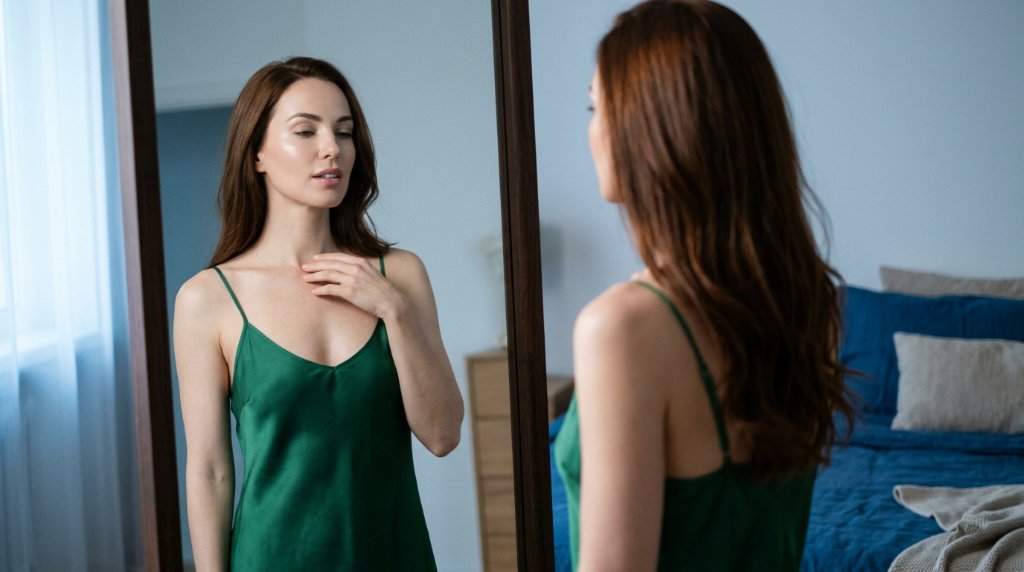
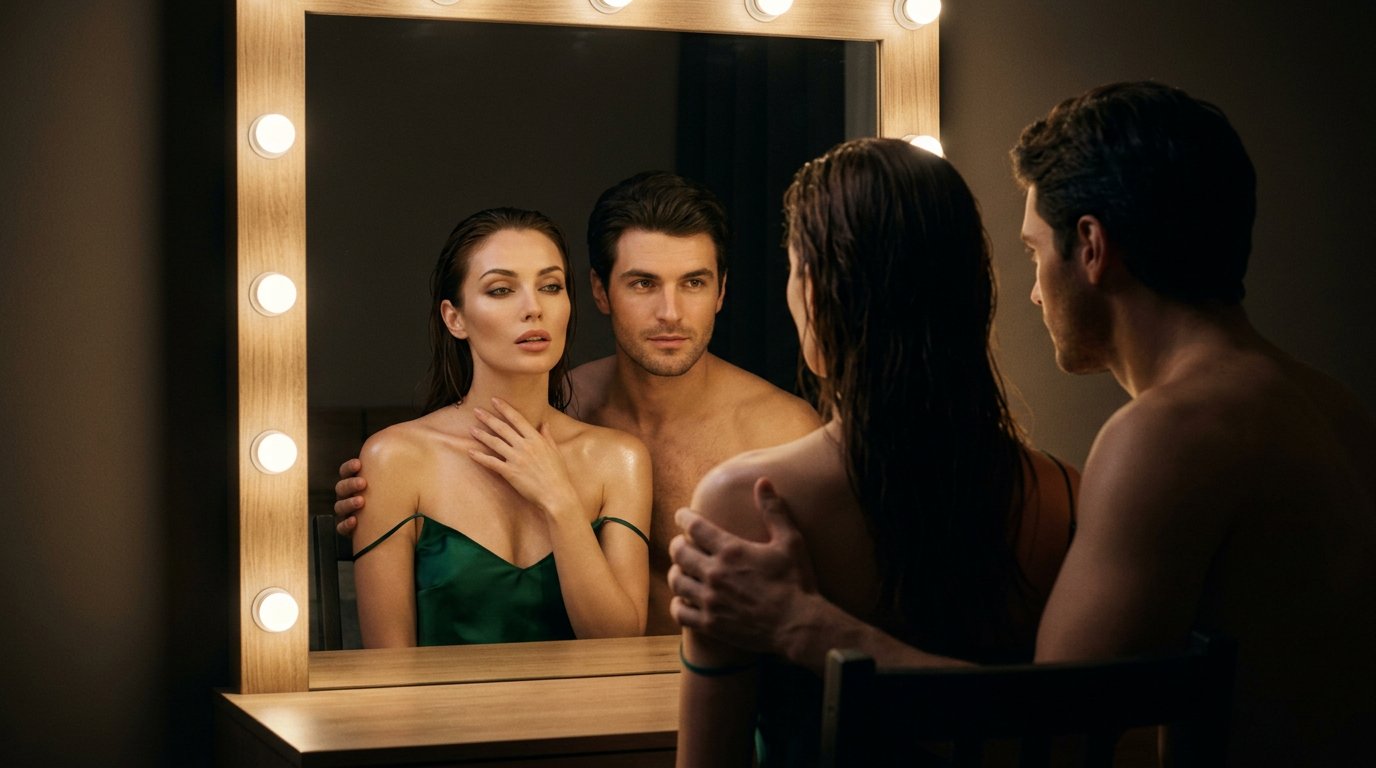
When beauty standards are borrowed from a screen, the mirror becomes a harsh judge — Image: AI-generated / Gemini 3.1 Flash via OpenRouter
Why Do Men Worry About Penis Size When Most Are Normal?
Veale and colleagues (BJU International, 2015) pooled studies in which a health professional used a standard measurement procedure, covering up to 15,521 men. Mean erect length was 13.12 cm (about 5.2 inches); mean erect circumference was 11.66 cm. Erect length was measured in only 692 men, so that figure is less precise. For comparison, the mean flaccid (pendulous) length in the same dataset was 9.16 cm.
A structured narrative review by Broul and colleagues in Sexual Medicine Reviews (2026) found that men requesting cosmetic penile enhancement often have dimensions within the normal range, so measurement alone cannot identify the problem. They distinguish small penis anxiety—disproportionate concern below a diagnostic threshold—from penile dysmorphic disorder, with preoccupation, repetitive behaviours, and distress or impairment. Evidence linking such requests to pornography was limited or indirect.
For most of these men, the problem is not the ruler but the benchmark they measure themselves against. The authors stress careful psychosexual assessment before any invasive procedure.
How Does Genital Self-Image Spill Over Into Desire and Satisfaction?
A systematic review by Barreto and colleagues in The Journal of Sexual Medicine (2025) pooled ten studies with 7,448 participants—2,280 men and 5,168 women—aged 18 to 72. Positive genital self-image was consistently associated with better sexual function, including more desire and satisfaction. Premature ejaculation and pelvic floor dysfunction negatively affected both genital self-image and sexual function, suggesting a two-way relationship.
Among women, there were no significant differences in sexual function between those who had genital cosmetic procedures and those who had not. Sociocultural factors, including dissatisfaction with genital size, harmed genital self-image especially among men. Limitations include a lack of longitudinal studies and limited population diversity. In other words, feeling better about one’s genitals and functioning better sexually tend to travel together.
Someone busy judging their own body during sex has less attention left for pleasure and connection with a partner. This fits the review pattern, although the review did not measure that mechanism directly.
What Would Freud Say About Measuring Ourselves Against the Impossible?
In his 1914 essay On Narcissism, Freud described an ego ideal: part of our self-love is transferred to an idealised image, and the actual self is measured against it. Pornography can fill that ideal with bodies chosen and styled for the camera, so a real healthy body seems “not enough.” This is an interpretive hypothesis, not a laboratory finding, to be read with the empirical evidence.
In clinical experience, once people see where their benchmark came from, stepping back becomes easier. For many Iranians, from Tehran to Toronto and Los Angeles, talking about genitals still carries shame, and silence strengthens private comparison. If worry about the body or genitals takes up much of the day, leads to avoiding intimacy, or thoughts of surgery without a medical reason dominate, speaking with a psychologist or sex therapist helps.
A review of twenty-six studies found an association between more frequent pornography exposure and more negative body image in men and women. That is not proof of cause; already dissatisfied people may watch more, so the direction remains open.
What is a “normal” penis size?
Clinical measurements of up to 15,521 men found a mean erect length of about 13 cm, or 5.2 inches. Most men seeking cosmetic penile surgery already fall within the normal range. Feeling small is usually driven by comparison, not by a measurement outside average norms.
Does porn affect women’s body image too?
Yes. The Paslakis review found the association in heterosexual women, not only men. Positive genital self-image is linked with more desire and satisfaction. Genital cosmetic procedures showed no significant difference in sexual function among women.
How can body image improve?
Knowing that pornographic images are selected and edited can reduce comparison. Comparing yourself less and having frank conversations with a partner about what actually matters to them often help. If worry dominates or leads to avoiding intimacy, professional help is appropriate.
Conclusion: From Comparison to Making Peace With Your Body
Research links heavy pornography use with a harsher view of the body, yet most bodies that feel inadequate are entirely normal. Body image is not fixed. Understanding where our benchmarks come from, comparing less, and speaking honestly with a partner can restore comfort and pleasure. The goal is not a different body, but a more peaceful relationship with the one you have. That shift begins with awareness and honest conversation, and it is possible.
Looking for professional support with your relationship or mental health?
Paslakis G, Chiclana Actis C, Mestre-Bach G. Associations between pornography exposure, body image and sexual body image: A systematic review. J Health Psychol. 2022;27(3):743-760. PMID: 33107365. DOI: 10.1177/1359105320967085
Barreto HGS, Saraiva ACC, Sousa ACSE, de Morais Gouveia GP. The impact of genital self-image on sexual function: a systematic review. J Sex Med. 2025;22(10):1839-1847. PMID: 40814202. DOI: 10.1093/jsxmed/qdaf194
Veale D, Miles S, Bramley S, Muir G, Hodsoll J. Am I normal? A systematic review and construction of nomograms for flaccid and erect penis length and circumference in up to 15,521 men. BJU Int. 2015;115(6):978-986. PMID: 25487360. DOI: 10.1111/bju.13010
Broul M, Hujová A, Jozífková E. Penile size anxiety, body dysmorphic disorder, and cosmetic penile enhancement requests: a structured narrative review and expert-derived assessment framework. Sex Med Rev. 2026;14(3). PMID: 42735405. DOI: 10.1093/sxmrev/qeag069
Freud S. (1914). On Narcissism: An Introduction. In: Strachey J, ed. The Standard Edition of the Complete Psychological Works of Sigmund Freud, Vol. 14. London: Hogarth Press; 1957: 67-102.
Image Credits
Featured image and in-text image — Image: AI-generated / Gemini 3.1 Flash via OpenRouter.