Scientific reviews treat sexual desire in long-term relationships as variable, not fixed. It shifts within a person and between partners, and it is shaped by individual, interpersonal and societal factors at once. No formula reliably keeps it alive, and most of the available research is descriptive rather than experimental.
What follows is what the evidence can and cannot support, including a review of 64 articles, a conceptual model, and a 2-year study of 217 couples. The aim is accuracy, not technique.
What does the systematic review say about keeping desire alive in long relationships?
A systematic review published in 2018 included 64 peer-reviewed English-language articles on maintaining non-clinical sexual desire in long-term romantic relationships. Findings were sorted with a socioecological framework into three levels: individual, interpersonal and societal, and the authors stress that desire ebbs and flows within and between individuals.
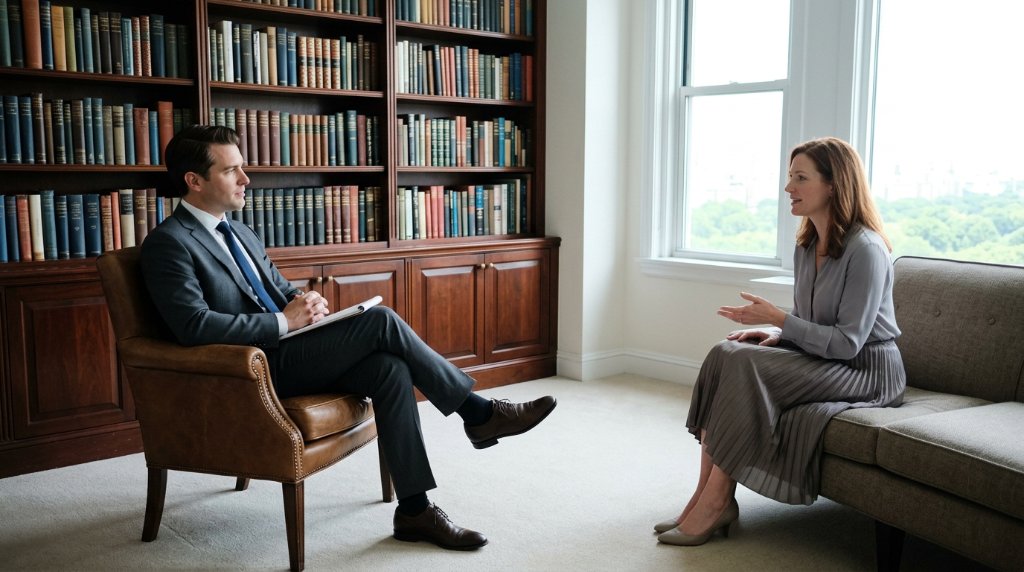
Desire rises and falls in a long relationship; reviews describe it as variable — Image: AI-generated / Gemini 3.1 Flash via OpenRouter
The review reports that desire problems are strongly linked to relationship problems, while the factors that maintain desire inside a relationship remain less well understood. The authors list limitations in this body of work and propose directions for future study.
The reach of that review is limited. It considered English-language articles only, so findings published in other languages are not included. [More research needed: most of this research is observational and cannot show that changing one factor, such as relationship satisfaction, itself keeps desire alive.]
Why should desire be seen between two people, not in one?
A theoretical review published in 2022 presents a conceptual model, inspired by systems theory, of how interactions between partners shape dyadic sexual desire in a romantic relationship. The model is used to understand fluctuations of desire in long relationships. It is a theoretical model, not an experimental result.
In this framing, desire is not only an individual state; it is shaped by interactions between the two partners. Because the model is conceptual, no measurable effect can be quoted from it.
Its value lies in where it directs attention: to what happens between two people, not only to what is inside one of them.
The 2018 review and the 2022 model point in the same direction: both place desire inside a context made of the relationship and its surroundings, not inside a single body. Neither one measures how much any single factor matters, so they describe where to look rather than what to change.
What trajectories were seen in couples followed for two years?
A longitudinal study published in 2026 followed 217 couples undergoing medically assisted reproduction for infertility. Sexual desire was measured at 5 time points: baseline, 6, 12, 18 and 24 months. Four trajectory classes emerged, mostly declining: steep decline with low desire at 10 percent, moderate desire at 27 percent, discrepant desire at 37 percent, high desire at 26 percent.
In the multivariable model, education and relationship satisfaction remained significant predictors of class membership. The authors stress the potential protective role of relationship satisfaction. That finding is a statistical association within one sample; it does not show that raising satisfaction would by itself lift desire.
The sample was highly educated and employed, mostly White and heterosexual, and there was no non-treatment comparison group, so these trajectories cannot be generalised to other couples, including couples who were not in treatment for infertility.
The editorial position of Behckam.com is that the available evidence shows desire in long relationships as variable and shaped by individual, interpersonal and societal factors, and offers no simple formula for keeping it.
If our desire has faded or become mismatched, what is a sensible step?
Instead of techniques or blame, the sensible step is a clear conversation between the partners about what has changed, together with a look at context: the relationship itself, mood, health and daily strain. If the change is distressing or unexplained, a professional assessment is reasonable.
In the consulting room, I treat a drop in desire in a long relationship first as a question about the relationship, not only about the body; my first question is when the change began and in which situations.
The evidence points to several levels at once rather than a single lever. A conversation that treats the change as shared is consistent with seeing desire between two people, and it avoids a hunt for a single fault. Should the change persist, or should it distress one or both partners, assessment by a clinician is a reasonable next step rather than an admission of failure.
Is it normal for desire to rise and fall in a long relationship?
The 2018 systematic review reports that desire ebbs and flows within and between individuals, so change over time is expected rather than a sign of failure.
Does relationship satisfaction keep desire alive?
In the 2026 longitudinal study, relationship satisfaction remained a significant predictor of trajectory class membership. That is an association in one sample, not evidence that changing satisfaction would preserve desire.
Do these findings hold for every couple?
No. The systematic review covered English-language articles only, and the longitudinal sample was highly educated, mostly White and heterosexual, with no non-treatment comparison group, so the trajectory results cannot be generalised.
Does mismatched desire mean the relationship has a problem?
A discrepant desire trajectory was identified in 37 percent of the 217 couples studied, in a sample undergoing medically assisted reproduction. The study does not establish that mismatch means the relationship is impaired; it documents a pattern.
Conclusion: What does the evidence say about keeping desire in a long relationship?
The evidence describes rather than prescribes. A systematic review of 64 articles sorted findings across individual, interpersonal and societal levels, and a 2-year study showed how varied couples’ paths can be. The percentage of couples with a discrepant desire trajectory in a sample of 217 couples undergoing medically assisted reproduction was 37 percent. That figure describes one sample and does not generalise; the hopeful point is that the factors involved can be talked about.
Looking for professional support with your relationship or mental health?
Mark KP, Lasslo JA. Maintaining sexual desire in long-term relationships: a systematic review and conceptual model. J Sex Res. 2018;55(4-5):563-581. doi:10.1080/00224499.2018.1437592. PMID: 29521522
Prekatsounaki S, Gijs L, Enzlin P. Dyadic sexual desire in romantic relationships: the Dyadic Interactions Affecting Dyadic Sexual Desire model. Arch Sex Behav. 2022;51(1):417-440. doi:10.1007/s10508-021-02165-8. PMID: 35031906
Rosen NO, Jabbour K, Marcotte-Beaumier G, et al. Patterns and predictors of classes of sexual desire trajectories in couples with medical infertility undergoing medically assisted reproduction. J Sex Med. 2026;23(8). doi:10.1093/jsxmed/qdag216. PMID: 42447399
Image Credits: The featured and in-text images in this article are AI-generated (Google Gemini); no real person appears in them.