The evidence indicates that many older adults remain sexually active, though the share falls with age. In a national probability sample of 3005 US adults aged 57 to 85, sexual activity was reported by 73 percent at 57 to 64, 53 percent at 65 to 74 and 26 percent at 75 to 85, with women less likely than men to report activity at every age band. In 4 European countries, past-year activity among adults aged 60 to 75 ranged from 61 to 91 percent depending on country and gender. Desire, on average, declines, but individual variation is wide.
Lindau 2007 drew on a national probability sample of 3005 US adults aged 57 to 85, comprising 1550 women and 1455 men. Women were significantly less likely than men at all ages to report sexual activity, and women were less likely than men to have a spousal or intimate relationship. Traen 2019 collected anonymous postal questionnaires in 2016 from probability samples aged 60 to 75 in Norway, Denmark, Belgium and Portugal. Across countries, 40 to 60 percent of participants reported being sexually satisfied. Having a partner was the most important positive predictor of sexual activity and satisfaction in all subgroups except Portuguese men. Masturbation was reported by 65 percent of Norwegian men and 40 percent of Norwegian women, and it was least common in Portugal. Partnered sexual activity was more frequent in southern Europe and solitary activity more frequent in northern Europe.
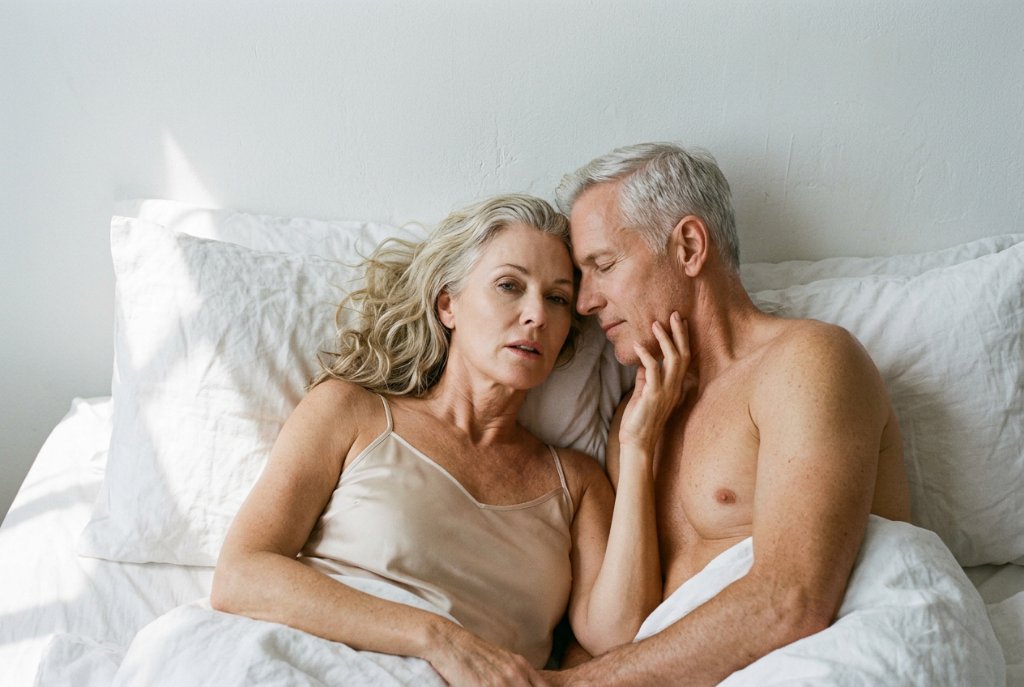
Sexual desire can continue into later life; AI-generated image.
Does sexual desire disappear with age?
No. Desire declines on average with age, but it does not disappear, and the spread between individuals is large. In the Berlin Aging Study II, older age went with less sexual activity and fewer sexual thoughts, yet not with differences in intimacy, and almost one third of the 60 to 82-year-olds reported more sexual activity and thoughts than the average younger adult.
Kolodziejczak 2019 analysed cross-sectional data from 1514 adults with a mean age of 68, half of them women. Compared with a reference sample of 475 adults aged 22 to 36, the older adults reported considerably fewer sexual activities and thoughts, with effect sizes above 0.60, but only slightly lower intimacy, with an effect size of 0.20. Psychosocial factors such as having a partner and relationship satisfaction accounted for considerable shares of variance in sexual activity and intimacy, whereas age and gender explained more of the variance in sexual thoughts. Participants reporting more loneliness reported less sexual activity and less intimacy, but not fewer sexual thoughts.
How common is low desire in older women, and what goes with it?
Low desire on a questionnaire is very common, but distress about it is not. Among 1548 women aged 65 to 79, 88.0 percent had low sexual desire, 15.5 percent had sexually related personal distress and 13.6 percent met criteria for hypoactive sexual desire dysfunction, meaning low desire together with distress.
Zeleke 2017 studied community-dwelling women aged 65 to 79 with a mean age of 71, of whom 52.6 percent were partnered. Hypoactive sexual desire dysfunction was more common among partnered than unpartnered women, at 23.7 percent versus 5.9 percent, and among sexually active than inactive women, at 31.5 percent versus 17.3 percent; 32 percent of partnered sexually active women and 22 percent of unpartnered sexually active women had it. Independently associated factors were being partnered, with an adjusted odds ratio of 4.21, vaginal dryness during intercourse at 2.37, symptomatic pelvic floor dysfunction at 1.92 and moderate-to-severe depressive symptoms at 4.15.
When and how should sexual problems be discussed in later life?
Discussion happens less often than the problems it addresses. Among sexually active respondents in the US sample, about half of both men and women reported at least one bothersome sexual problem, yet only 38 percent of men and 22 percent of women had discussed sex with a physician since age 50, and 14 percent of men had used medication or supplements to improve sexual function.
In clinical work with older adults, specialists often see that the idea that desire belongs to youth leads people to treat declining desire as a personal failure and to stay silent about it.
[More research needed: most of these studies are cross-sectional and cannot show how desire changes over time within a given person.]
The editorial position of the Behckam.com site is that desire and sexual activity in later life are individual matters, as at any age, neither a duty to perform nor a weakness to hide.
Yes, many are. In the US sample of 3005 adults aged 57 to 85, sexual activity was reported by 73 percent at 57 to 64, 53 percent at 65 to 74 and 26 percent at 75 to 85, and women reported less sexual activity than men at all ages. In European samples aged 60 to 75, past-year activity ranged from 83 to 91 percent in men and 61 to 78 percent in women.
Does sexual desire naturally disappear in later life?
No. In 1514 adults with a mean age of 68, older age went with less sexual activity and fewer sexual thoughts but not with differences in intimacy, and compared with 475 adults aged 22 to 36 the older group showed only slightly lower intimacy. Almost one third of the 60 to 82-year-olds exceeded the average younger adult on sexual activity and thoughts.
How common is low desire among older women?
Among 1548 women aged 65 to 79, 88.0 percent had low sexual desire on the questionnaire, while 13.6 percent met criteria for hypoactive sexual desire dysfunction, meaning low desire together with distress. In Lindau 2007, low desire was reported as a bothersome problem by 43 percent of sexually active women, ahead of lubrication difficulty and inability to climax.
Do older adults talk to a doctor about sexual problems?
Rarely. In the US sample, about half of sexually active respondents reported at least one bothersome sexual problem, yet only 38 percent of men and 22 percent of women had discussed sex with a physician since age 50. That leaves most reported problems undiscussed, even though several associated factors are ones a clinician can assess.
What the research concludes about desire and sexual activity in later life
Across these surveys, sexual activity was reported by 73 percent of adults aged 57 to 64 and 26 percent of those aged 75 to 85, while low sexual desire reached 88.0 percent among women aged 65 to 79 and distress about it only 15.5 percent. Desire and sexual activity in later life vary widely between individuals, and several factors associated with desire, such as vaginal dryness during intercourse and depressive symptoms, can be assessed in a clinical conversation, which makes silence the least useful option.
Looking for professional support with your relationship or mental health?
Lindau ST, Schumm LP, Laumann EO, Levinson W, O’Muircheartaigh CA, Waite LJ. A study of sexuality and health among older adults in the United States. N Engl J Med. 2007;357(8):762-74. PMID: 17715410. DOI: 10.1056/NEJMoa067423
Træen B, Štulhofer A, Janssen E, Carvalheira AA, Hald GM, Lange T, et al. Sexual Activity and Sexual Satisfaction Among Older Adults in Four European Countries. Arch Sex Behav. 2019;48(3):815-829. PMID: 29987546. DOI: 10.1007/s10508-018-1256-x
Kolodziejczak K, Rosada A, Drewelies J, Düzel S, Eibich P, Tegeler C, et al. Sexual activity, sexual thoughts, and intimacy among older adults: Links with physical health and psychosocial resources for successful aging. Psychol Aging. 2019;34(3):389-404. PMID: 31070402. DOI: 10.1037/pag0000347
Zeleke BM, Bell RJ, Billah B, Davis SR. Hypoactive sexual desire dysfunction in community-dwelling older women. Menopause. 2017;24(4):391-399. PMID: 27824686. DOI: 10.1097/GME.0000000000000767
Image credits: Featured image: Photo: T Leish / Pexels. First image: Photo: SHVETS production / Pexels