What do Tinder users really experience? Drawing on 2025 sentiment analysis of app-store reviews and a longitudinal hookup study among college students, we examine how
Reviews of Tinder in Poland were predominantly negative. The average rating was 2.67 out of 5 on Google Play and 2.71 out of 5 on App Store, and the written comments behind those scores described cost, repeated unwanted contact and the emotional toll of using the app without success. This is the picture that emerges from an analysis of user-written reviews published by Waszak, Łuszczak and Zagożdżon in 2025 in Psychiatria Danubina.
The dataset consisted of 9,831 Google Play reviews and 397 App Store reviews, processed with sentiment analysis. Most of them described ordinary frustration with the product: paywalls, technical faults, disappointing matches. Clinically significant material was rare. Among the lowest-rated reviews, psychiatrists identified 16 containing mental-health-hazard content: 6 related to depression, 6 to low self-esteem, 2 to suicide-related content, and 2 to harassment.
Two methodological limits deserve emphasis. The sample is self-selected, because people write reviews when they are angry rather than when they are content, and the ratings describe the app rather than the users. A negative review is not a diagnosis. What the data do show is that a minority of users describe psychological harm in their own words, and that this material is concentrated at the extreme end of dissatisfaction.
Sentiment analysis counts ratings and words, not clinical interviews, and the psychiatric reading of 16 reviews is a qualitative judgment applied to a small subset of a large corpus. The finding is therefore best treated as a signal that warrants attention rather than as an estimate of how often harm occurs.
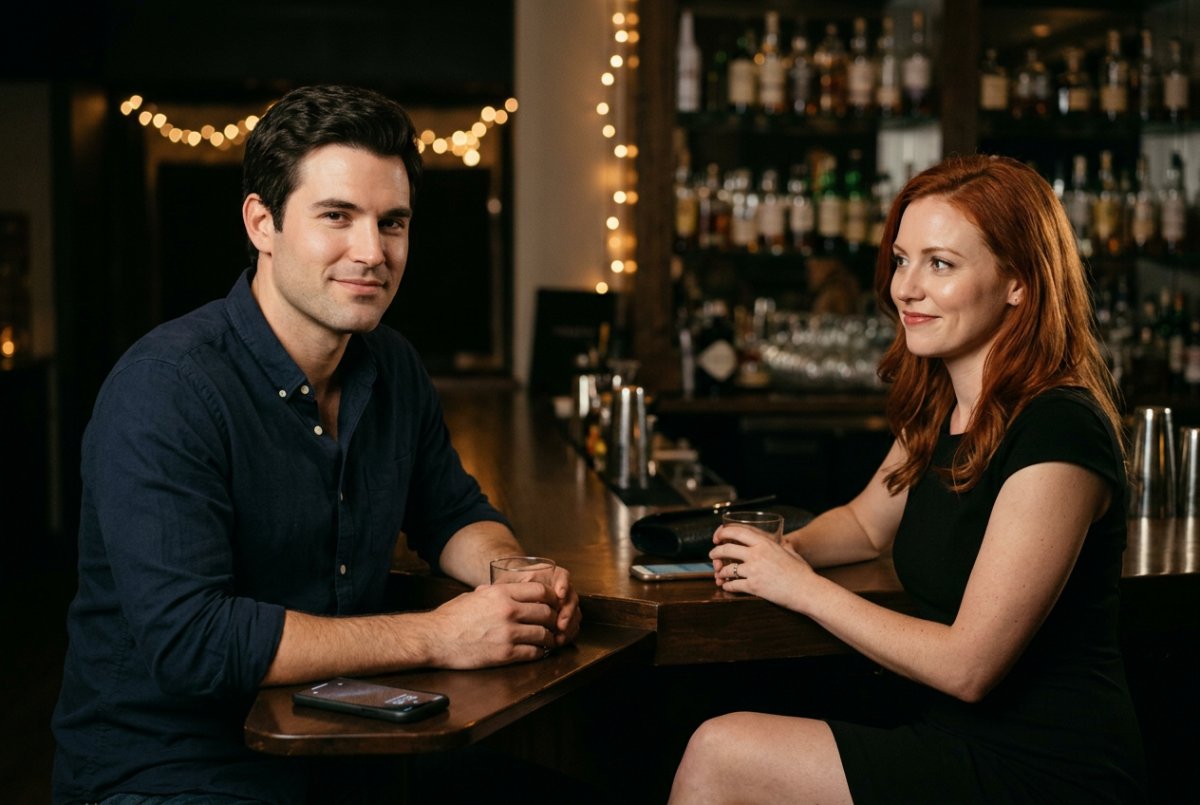
A first face-to-face meeting after matching on Tinder
Does app-enabled casual sex harm mental health?
Longitudinal evidence points to casual sex as the earlier event: well-being tends to decline afterwards, and the reverse pathway is weaker. Yu, Shen and Zuo (2024, International Journal of Sexual Health) followed 833 Chinese college students at 6-month intervals. Students who reported hookup behavior showed poorer psychological well-being 6 months later, with lower life satisfaction and higher psychological distress, than students who did not.
The temporal order is what makes this result informative. The direction was one-way — prior psychological well-being did not predict later hookup behavior; the casual sex came first, followed by the decline in well-being, not the reverse. That removes the simplest alternative explanation, namely that unhappy people seek casual sex more often. It does not show that every encounter causes harm.
Group averages conceal the distribution. A mean decline in life satisfaction can coexist with many individuals who were unaffected, and with others who reported a better mood. The study describes a tendency within a population, while a clinician meets a single person at a time.
Sampling also matters. Students who volunteer for a 6-month longitudinal survey are not identical to the general population of app users, and not all encounters reported in such research are arranged online. The mechanism linking the encounter to later distress therefore remains partly inferred rather than directly observed.
The morning-after solitude following a casual encounter
Why do some people report a different experience?
Neither dataset shows a uniform effect, and both allow for neutral or positive outcomes. In the Tinder reviews, only a small fraction of the lowest-rated comments contained mental-health-hazard content; most complaints concerned money, matching and technical faults. In the student sample, an average movement toward distress leaves room for people whose well-being did not change or improved.
For some people, app-enabled casual sex is neutral or even positive: it answers curiosity, softens loneliness for an evening, and confirms that they are desired. For others it arrives with a sense of worthlessness and lower self-esteem that can persist for days.
What separates these outcomes is usually not the physical act. The determining factor is often the meaning a person assigns to the encounter, not the encounter itself. An encounter read as mutual, chosen and honest sits differently from one read as a performance, a transaction, or a test that must be passed. Prior mood, expectations, the behavior of the other person afterwards, and the account a person gives of themselves all feed into that meaning, which is why the same event can leave some people settled and others unsettled. This does not make the encounter unimportant. It makes the interpretation of it decisive.
When is it worth discussing this experience with a specialist?
Distress after an encounter arranged through an app is common and often passes on its own. It is worth discussing with a specialist when it repeats, when it lasts for weeks rather than days, when it changes how a person regards themselves, or when it begins to govern decisions about whom to meet and why. Persistent low mood, a settled sense of worthlessness, harsh self-criticism after encounters, and any suicidal thinking are reasons to seek an assessment rather than wait.
Among clients who bring up sexual encounters arranged through dating apps, a common pattern is seen: the emptiness felt afterward usually comes not from the encounter itself, but from the absence of shared meaning with the other person.
None of this means that dating apps are inherently harmful, or that casual sex must be avoided. It means that the emotional aftermath deserves attention rather than dismissal. People who examine what they are seeking, and who notice when an encounter leaves them feeling worse rather than better, usually regain a sense of choice. That capacity to choose deliberately, rather than react, is a reasonable place to begin.
What do user reviews say about Tinder?
An analysis of Polish app-store reviews reported average ratings of 2.67 out of 5 on Google Play and 2.71 out of 5 on App Store. Among the lowest-rated reviews, 16 contained mental-health-hazard content.
Does casual sex always lead to worse mental health?
No. A 6-month longitudinal study of 833 students found an average decline in well-being after hookup behavior, but averages hide individual differences. Some people are unaffected or report positive experiences.
Why do people react differently to this experience?
The meaning assigned to the encounter, before and afterwards, appears to matter more than the encounter itself.
When does this topic need professional help?
When distress persists, repeats, damages self-worth, or includes suicidal thinking, an assessment with a qualified clinician is appropriate.
Waszak P, Łuszczak E, Zagożdżon P. Tinder user stories and mental health – Sentiment and content analysis of app-stores reviews. Psychiatria Danubina. 2025. DOI: 10.24869/psyd.2025.456
Yu K, Shen P, Zuo G. The Longitudinal Relationships among Casual Sex and Psychological Well-Being in Chinese College Student. International Journal of Sexual Health. 2024. DOI: 10.1080/19317611.2024.2317195
Looking for professional support with your relationship or mental health?
Browsing a dating app alone at night — Image: AI-generated / Gemini 3.1 Flash Image via OpenRouter A first face-to-face meeting after matching on Tinder — Image: AI-generated / Gemini 3.1 Flash Image via OpenRouter The morning-after solitude following a casual encounter — Image: AI-generated / Gemini 3.1 Flash Image via OpenRouter